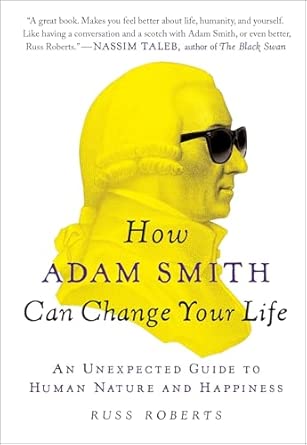
How Adam Smith Can Change Your Life
I picked this up without much expectation and it sent me somewhere I do not usually go.
Roberts is not writing about The Wealth of Nations. He is writing about the book Smith published in 1759 and almost nobody reads, The Theory of Moral Sentiments, which is about how to be a decent person. So the whole thing is an argument made out of a text that is more than two hundred and fifty years old, aimed at the way you will behave this afternoon. That gap is the point. We spend an enormous amount of energy looking for the next idea, the newer framework, the thing that just came out, on the assumption that forward is where the answers live. Sometimes the useful thing has been sitting there the whole time and the work is remembering to look behind you.
What Smith is actually asking is a question we have quietly stopped asking each other. What is a good life. Not what does a good life require, or cost, or look like from the outside. Nobody puts that question on the table anymore. We have replaced it with an inventory, and the inventory is made of things, and we assume the inventory answers the question.
I want to be careful about how I take that, because it is easy to hear as a lecture against owning anything. It is not. Smith's warning about wealth and fame does not land on me as an instruction to want less. It lands as an instruction to know what I actually enjoy, and to notice when I have started leaning on those things to feel like the day went well. Enjoying something and depending on it to tell you that you are all right are two different arrangements, and the second one will fail.
Then there is the line the book turns on. A person wants not only to be loved, but to be lovely. To be worthy of it. Roberts spends most of the book on the distance between those two, and the distance is where people get hurt. You can chase being loved directly. It works, for a while. And a person who has arranged to be admired for something he knows is not true about himself has built something that has to be maintained forever and cannot survive being examined. Misfortune does not always arrive from outside. Sometimes you assemble it, one small piece at a time, by not understanding which of the two you were pursuing.
I do not usually read philosophy dressed as anything, let alone philosophy dressed as an economics book. This one made me want to.